


As an underwater explorer for nearly forty years, only a handful of my discoveries have had a direct connection to living people, but those few have been the most satisfying and poignant of my career. It’s even rarer when our discoveries can correct a historical “wrong” and enable a wartime hero to receive recognition 72 years after the fact! In this unique case the shipwreck had been discovered years earlier by others, and at the time was a significant discovery. Our recent expedition was to explore and film the shipwreck for a documentary film, but a close review of the facts surrounding the sinking would ultimately bring me to the highest levels of the Pentagon.
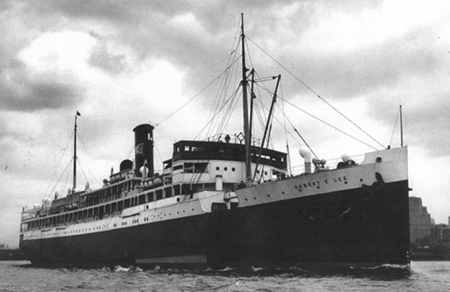
The summer of 2014, I participated on mission # NA045 aboard the Exploration Vessel Nautilus with Dr. Bob Ballard. The EV Nautilus travels the world’s oceans exploring and educating through live telepresence with its many global partners. The 2014 field mission would bring it into the Gulf of Mexico for a combination science mission and shipwreck project. The science aspect was to recover specimens from “brine pools”, depressions in the seafloor that have an incredibly dense concentration of salt and give the visual mirage of a rippled lake at the bottom of the ocean. This natural phenomenon is a unique ecosystem that has developed a symbiotic relationship to feed on methane in order to survive. This is absolutely fascinating science, but for me the highlight of this expedition would be the exploration of the German submarine U-166 and her final victim the Robert E Lee, both of which had been accidentally discovered in 2001 by C & C Technologies while surveying a planned deep water pipeline route for various oil companies.
I was aboard to assist with a NOVA/National Geographic documentary film about the German submarine offensive against America during World War Two. Having explored and documented U-boat wrecks on both sides of the Atlantic, I know the subject well, and the six years I spent working on the wreck of a previously unknown U-boat wreck off the coast of New Jersey has made me an expert on the type IX German U-boat. Sitting next to Bob in the control van, my job would be to detail the technology on U-166 and discuss the events leading up to and around the sinking of both U-166 and Robert E. Lee. It would be here that certain facts would surface which prompted Dr. Ballard to set the wheels in motion that would ultimately change the US Navy’s account of the sinking, and get a hero the medal he deserved.
July 1942 Gulf of Mexico

Since the opening blows of operation “Paukenschlag” (translated as “Drumbeat”) the German naval offensive against America which began in January 1942, German U-boats had been operating nearly unchecked up and down the eastern seaboard of the United States, racking up an incredible tally of sunk and damaged ships. The Germans battle plan was simple; wage a “tonnage war” against the allies, sinking ships and their cargos faster than they could build or replace them. In those first few months, from Maine to Florida ships exploded and pools of burning oil served as funeral pyres in what the U-boat sailors coined “the great American turkey shoot”. In July 1942, the 5,184-ton passenger/freighter Robert E. Lee departed Trinidad and headed directly into the newest killing zone. Aboard were 407 souls, some were survivors of other ships recently sunk by German U-boats in the waters surrounding the Caribbean. To stave off destruction the Robert E. Lee was armed with a stern mounted deck gun and was being escorted by the American patrol craft PC-566 for the journey to Tampa Florida.
Built by the Brown Shipping Company, the PC-566 was a 174 foot long patrol craft designed for patrol and convoy operations. With a 3” deck gun, machine guns, rocket launchers, and depth charges racks, the small vessel packed a punch. Captain H.G.
Claudius and his sixty-five man crew felt ready for whatever the Germans threw at them. Arriving at Tampa Bay, the plan quickly changed when no harbor pilot was available to guide the large ship into the harbor. Communicating by blinker-lights, the Robert E. Lee requested PC-566 escort them toward the safety of New Orleans Louisiana, just over 400 miles away. At this point PC-566 broke radio silence, requesting permission to continue escort duty all the way to New Orleans, which was summarily approved.
The weather was clear with smooth seas and at 4:30 in the afternoon, the two vessels were only 45 miles southeast of the Mississippi River Delta when PC-566 once again broke radio silence, advising his superiors of his arrival time, and requested a harbor pilot and fuel for his vessel. This message was only partially sent as a torpedo had been sighted in the water. With no time to maneuver out of its path the torpedo struck the Robert E. Lee’s starboard side aft of the engine room, the massive explosion buckling up the decks and destroying the radio room. The ship began to founder immediately.
Aboard PC-566 Captain Claudius had already sprang into action, increasing speed and chasing down the track of the torpedo towards the submerged U-boat. The crew of the PC-566 was shocked to see the U-boats periscope come out of the water to enjoy its handiwork. Racing over the swirl where it descended, the patrol vessel dropped a brace of five depth charges on top of the descending U-boat. At this moment Captain Claudius noted the Robert E. Lee had disappeared, having sunk in less than ten minutes. Reestablishing sonar contact, the PC-566 roared once again over the U-boat’s position and a dropped another set of depth charges. As the explosions subsided, all sonar contact with the submarine was lost. A large pool of oil was spreading, but the entire area was fouled with flotsam making it impossible to differentiate what may have come from the U-boat or the passenger liner. Captain Claudius felt certain he had killed the U-boat but had no evidence to prove otherwise. PC-566 radioed command about the passenger ship’s destruction and requested assistance with rescue operations.
Drifting among the flotsam and oil that was once the Robert E. Lee was seven life boats all packed with survivors, with even more people in the water. Many of the survivors were burned and injured, and the worst cases were brought aboard the small escort for first aid. Over the next few hours US Navy seaplanes arrived, each landing in the water, and then took the worst of the injured to various hospitals. Within hours rescue ships arrived on scene and the remaining survivors pulled from the water. The now empty life boats were sunk by gunfire, and all ships headed to Venice Louisiana, arriving on July 31. Of the 407 people on the Robert E. Lee twenty-five perished in the attack and sinking; ten crewmen and fifteen passengers.
Two days after the Robert E. Lee was sunk, US Coast Guard patrol plane # V-212 attacked a U-boat near Isles Dernieres, Louisiana. The plane, a Grumman J4F-1 Widgeon seaplane, was on routine anti-submarine patrol and the pilot felt he damaged the U-boat with his depth charge because after his attack he could see a large spreading pool of oil. The sighting of a U-boat just two days later and a 130 miles distant from the Robert E Lees sinking put into question PC-566’s claim that it had severely damaged, let alone destroyed, a submarine.
The crew of the PC-566 was not given a hero’s welcome when they returned to port; rather Captain Claudius was admonished by his superiors. First “for breaking radio silence twice prior to his arrival” and secondly for “not being in the proper patrol station, nor that any proven system of attack was followed”. The report went on to add that “it is not considered probable that any except minor damage could have been sustained by the submarine”. Stripped of his command of PC-566, Captain Claudius was sent to the Submarine Chaser Training Center in Miami Florida for additional training. It was clear that the Commander of the Gulf Sea Frontier had little to no faith in the PC-566’s claim, or ability to sink a U-boat.
Post war: 1945
At wars end almost seventy five percent of Germany’s submarines had been destroyed or was missing in combat operations. Often there was no evidence from a destroyed U-boat to prove a “kill”, so how do you determine which U-boat had been destroyed? To answer this question, military assessors were tasked with determining the fate of EVERY U-boat built and with a keen eye toward those unaccounted for at wars end. There were very real fears that high ranking Nazi officials may have escaped justice and even the fate of Adolf Hitler was still unclear. Given what was at stake, this was a major undertaking of the utmost importance.

The assessors used two forms of evidence to arrive at a consensus for a U-boats fate: 1) captured German records of all U-boat’s “missing in action” and 2) dates and locations of attacks against U-boats. With both sets of data in hand they would make a connection, simply matching up the locations and dates. When the assessors looked at the records for the U-166 they found it failed to answer its radio and declared missing in action on August 1, 1942 …the SAME day the Coast Guard patrol plane V-212 attacked and claimed to have sank a U-boat in the Gulf of Mexico. To the assessors this was a neat and tidy package that clearly explained the loss of U-166 so the Coast Guard aircraft was given credit for sinking the U-166. Although the pieces fit so nicely, the die had been cast for history to be penned incorrectly.
ULTRA: TOP SECRET
What the post war assessors did not know was called “ULTRA” and it was without fail, the greatest secret of World War Two. British intelligence sporadically decrypted German

radio messages and shared information concerning the activities of enemy submarines with the US Navy. These decrypt’s were code-named ULTRA TOP SECRET and was carefully used to route merchant ships around U-boat wolf-packs and destroy enemy submarines in such a way the Germans never knew their codes had been broken. One such decrypt dated July 30, 1942, is an estimate for enemy submarine’s within the Gulf Sea Frontier” and reads: “ two patrolling off Mississippi Delta-Gulf coast area between 88 degrees and 91 degrees West”. This decrypted information was accurate; there was indeed two U-boats operating in the Gulf of Mexico at the same time, the U-171 and the U-166, but unfortunately due to wartime secrecy this information was not shared with the assessors and all “ULTRA” secret’s remained classified until 1974.
U-171 was a type IX U-boat and after a successful war patrol in the Gulf of Mexico in which they sank three ships, the U-171 headed back to her French base but struck a mine in the Bay of Biscay and sank rapidly. The commanding officer was among those who survived and was required to testify about the loss of his boat. During those hearings the Captain re-constructed his log from memory and described being attacked off the coast of Louisiana by a seaplane that dropped a single depth charge “which shook up the boat, but did no damage”. This was the attack made by V-212 on August 1, 1942, which did not end in a kill, but only a near miss as U-171 escaped unscathed.
U-166 was also a type IX U-boat. Oblt. Hans-Gunther Kuhlmann was her commanding officer for two war patrols and credited with sinking four ships. Ordered to mine the mouth of the Mississippi River the U-166 radioed U-Boat Command upon completion of this assignment and was seeking targets of opportunity when she crossed paths with and attacked the Robert E. Lee. At the time of her loss, the U-166 had a crew of fifty–two men.
Post Script December 2014

For 56 years the truth was unknown and resting in perpetual darkness 5000 feet down and just one mile from the wreck of the Robert E. Lee. As for Captain Claudius, he and the crew of the PC-566 did the job they were trained for and they did it right. Although the Robert E. Lee was lost, the crew of the PC-566 acted in the finest tradition of the US Navy, exacting swift and terrible retribution for the U-boat’s actions. Sadly, Captain Claudius passed before the wreck of the U-166 was located, and never knew of his successful attack. In recounting these details to Bob aboard the EV Nautilus, I made the offhand comment that I felt the US Navy had not (at the time), treated Captain Claudius and his crew fairly. Even with the wreckage having been located and proving him a hero back in 2001, they had still not corrected the record. Bob agreed that this oversight needed to be fixed, and right then and there made a satellite call to a shipmate of his, US Navy Admiral Jonathon Greenert, the current Chief of Naval Operations, who promised to look into it. The wheels of Government may move slowly but eventually they do move.
On December 16, 2014, I was honored to join Bob in the Pentagon as the Secretary of the Navy, Ray Mabus, and CNO Admiral Greenert, awarded Captain Herbert Claudius (posthumously) the Legion of Merit for valor in action for the destruction of U-166. Captain Claudius’s son Gordon was present and accepted on his father’s behalf. It was then and there, while shaking Gordon’s Claudius’s hand in the Pentagon that the connection between past and present, and of a deep sea mystery 5000 feet down, finally came to the surface. It is what I love about being a shipwreck explorer, the chance for our work to make a difference in people’s lives.