
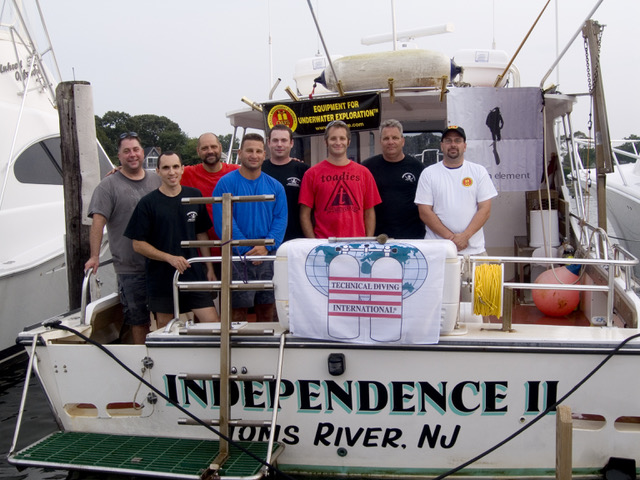
Webster’s dictionary defines an expedition as “a journey of some length or difficulty for a definite purpose.” So a charter to, let’s say, the Andrea Doria, is an “expedition” in the literal sense, but
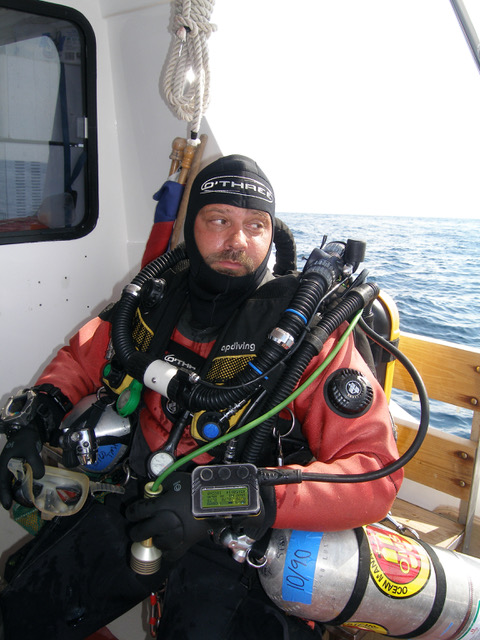
Expedition Diving is much more complex than a 250-foot Doria penetration, or push to lay new line in a cave. Definitions vary by perspective, and mine is that Expedition Diving is a team-driven project, generally deep (300 feet+), with long run times (4-8 hours), and, as such, the bottom divers can’t physically carry enough gas to be self-sufficient — whether it’s deco gas for open circuit, or bailout gas for a closed circuit endeavor. These dives are focused on specific goals, being organized and planned months in advance, the Lusitania and Britannic expeditions being prime examples. A detailed dive plan or SOP (Standard Operating Procedure) is drafted, outlining EVERYTHING related to the project, from initial mobilization to post- dive breakdown. All possible logistical, equipment, and operational considerations are recognized and addressed. Gas calculations, material requirements, and emergency protocols are planned with layered support and backup. The SOP must clearly guide the team through the expected and emergency (oh, crap!) situations, and account for the physical and material requirements needed to get the bottom divers back to the surface regardless of the what, why, when, or where. No matter how well you plan and prepare, once heads are underwater there is always inherent risk. The million dollar questions are where to draw the line and how much risk is acceptable?
Prior to my first expedition type dive, I always carried all the gas I needed to make a dive, leaving nothing to chance. Gas waiting on the anchor line, under the boat, or even the dive boat itself for that matter, might not be there when I needed it. Eventually, my open circuit trimix dives hit a wall, limited by how much gas I could carry and the risk I was willing to assume. On deep dives, a buddy could be more of a liability than a benefit. Most of the time I chose to dive alone; if someone did have a gas problem, we simply didn’t carry enough gas for two. Comfortable in my gas management, it’s a risk I was willing to assume. But push that line, something really bad was going to happen. I’ve been jumped twice by out-of-air divers on Andrea Doria expeditions. The first time it happened I was blindsided and nearly drowned, having never seen it coming. The second instance, I saw the diver coming at me, hand slashing across his throat. But despite my offer of a backup regulator, I was bowled over and he yanked the one out of my mouth. In both cases, emergency gas was dropped over the side of the dive boat, and both only suffered bruised egos and made the captain’s “boat’s full list.” Both incidents occurred at twenty feet under the boat, and it seemed it was only a matter of time before someone had a major gas issue at depth. That cold reality hit on a 280-foot dive after having just located the German U-boat, U-215, on the Georges Banks 150 miles off Shelburne, Nova Scotia. It was a fantastic dive; everything had gone well, that is until I noticed the other two members of my team buddy breathing on the ascent. The tide was roaring and it was everything we could do to hold on to the down/ascent line. A pea soup fog had come in, so our planned drift deco had been flagged. Our one support/safety diver had a problem (with his then new-fangled CCR) and never splashed, so topside was unaware of the drama unfolding below. When it rains, it pours. Splitting one cylinder of deep deco gas, the pair barely eked out a marginal profile, surfacing a little pale but none the worse for the wear. When I surfaced, every gauge I had was in the red, and had I been asked for gas, I had none to give. That’s as close to the line as I ever want to be.
My switch to a closed circuit rebreather provided me a quantum leap in range, but required a total reworking of technique and philosophy. Like a new open water diver, the importance of a dive buddy returned, but with new significance: the bailout gas carried by a buddy is factored into my dive/emergency plan, as my bailout is into his. We are partners now, and on deeper dives three to four divers with a communal bailout gas plan is not uncommon, but requires a much greater obligation to stay together — a far cry from “same dive, same ocean” mentality of days past. As a member of a CCR dive team, I have expanded my available bailout and make a commitment to accept the risk limits of my partners. With CCR we are now making amazing dives, but the limits of how much bailout gas a team can carry and the amount of risk we are willing to assume still exists.
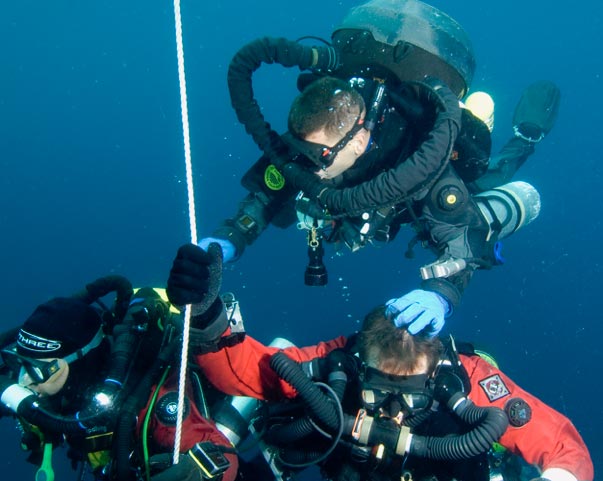
A major component of Expedition Diving is the support divers, whose single most important task is to provide gas (or back up CCR) to bottom divers in a major unit failure. Layered support provides the ability to handle multiple situations so that no matter what issue or combination of problems arises, the decompression phase is uninterrupted and as stress free as possible. Besides their assigned jobs for the normal or planned dive, emergency scenarios such as diver adrift, gas loss, electronics failure, loop flood, and even an unconscious diver are discussed and prepared for with a planned reaction and assignment. Everyone clearly knows what is expected of him in case of a problem. Long runtimes clock out the OTU’S, and a CNS oxygen toxicity seizure during the long decompression phase is a very real possibility. Support divers are in the water with the dive team during the entire hang, diligently monitoring them, ready to lend assistance and surface a convulsing diver. The number of support divers, (deep, intermediate, and shallow), is determined by the gas needs of the bottom divers, environmental conditions, the size of the dive platform, and having more support divers in the water is not always better.
The Dive Marshall (aka Diving Supervisor) is the “go-to guy” running the dive operation topside; liaising with the captain and support crew, tracking all divers’ times and assigning tasks to support divers as required by schedule or emergency. In short, the DM is the final word on everything that pertains to the dive. Mirrored after military and commercial operations, the SOP and its command structure is designed to control all activity on the back deck, ensuring that all aspects of the dive operation are monitored and provide a clear and concise emergency protocol if needed, all with a nod to the limits of a sport diving team’s resources.
This article is not intended as a draft for an SOP, nor could I, in the limited space, list all the nuance and detail covered in a well thought out dive plan. There are many ways to run an Expedition Dive and no single SOP that will work in every situation. The key is to HAVE a written plan which covers all contingencies and failures, distribute and discuss the plan with the team, assigning tasks and responsibilities for both standard and emergency operations. When I am questioned about how I execute these dives, or what gases I would use, etc., I often (half jokingly) say, “Don’t follow me, I ain’t leading!” But the truth is we all follow in the tracks of previous explorers who push the envelope, and (hopefully) learn what worked and then expose, analyze, and correct what didn’t. Each dive team needs to adapt their SOP to the unique set of conditions and parameters they face on their project. Where the footprints ended for the previous explorers, the next group goes a few steps further.
Further doesn’t have to mean far away and exotic. More CCR divers are pushing the line deeper, and Expedition Diving isn’t just being done with large teams on historic wrecks like Lusitania, or Britannic. Awesome technical dives are happening in our own backyards. When I broached the idea of running an Expedition Dive to a 400-foot deep virgin wreck site to Dan Bartone, captain of the New Jersey based dive charter boat Independence II, he didn’t blink, only asked me, “When?”
I’ve known Danny for years and, as expected, the questions came fast and furious. “Where’d you get the numbers? They good? Who’d you have in mind?” I told him the numbers are solid; they came from one of my Dad’s fishing pals. It’s big, with sixty feet of relief, but it’s 100 miles offshore, near the Hudson Canyon.
“Canyon huh? 400 feet deep and 60 feet of relief? Yup, that’s what he says. “Cool!” I don’t believe anyone has ever tried to dive out there before, Danny. “I am sure of it, so how we going to do this safely?” That’s a good question.
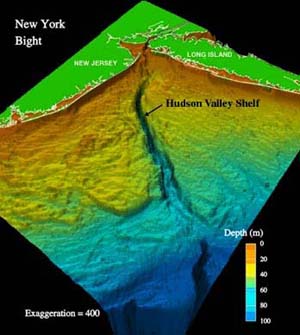
For 10,000 years, New York’s Hudson River has gouged a trough in the sea floor that extends a hundred miles out into the ocean, right to the edge of the continental shelf. It’s here that the Hudson Canyon begins as a sharp-edged crack whose sheer walls plummet three-quarters of a mile down into the abyss. Comparable to the Grand Canyon in size, it is one of the largest submarine valleys in the world, for years drawing fishermen as the spot where currents collide, baitfish churn the surface, and giant tuna, billfish, and iridescent mahi-mahi cruise with torpedo-like speed. On NOAA chart #12300, there is a wreck icon in 400 feet of water that appears to teeter on the line demarcating the edge of the canyon wall and the sheer drop 1,200 feet down to the canyon below. Those who have fished it claim the wreck is huge, with ghost nets shrouding the upper sections, and a vicious current that runs at 3-4 knots. Probably with good reason, no one has ever tried to dive here before.
Borrowing heavily on the lessons learned and protocols established on the 2006 Britannic expedition I led with John Chatterton, I began to outline our “Tip of the Canyon” SOP with Captain Dan, but there were major differences. On Britannic, I had a twenty-five-man team with twelve bottom divers, working for two weeks from an eighty-foot vessel three miles from shore in warm clear water. The Tip of the Canyon project had a shoestring budget in a “one and run” operation that was one hundred miles out at sea. The conditions were night and day as the warm clear Aegean was replaced by the dark and cold North Atlantic and, unlike Britannic, we were carving our own path with no idea what to expect from conditions or what we might find on the bottom. The currents reported at the site could be too strong to dive, and there was real concern of the waterfall effect — a down welling over the edge of the continental shelf where tide and current meet — that could hamper or prevent ascent. Recognizing all the possible problems, then factoring in the unique conditions and planned responses, the SOP took form. We could not and would not compromise on safety.
Based on the amount of emergency open circuit bailout required for the planned dive profile, we decided upon a three-man dive team. The divers had to be experienced CCR wreck divers with dives to over 300 feet and be familiar with the conditions experienced in the North Atlantic. The evil you know is better than the one you don’t, so I pegged two personal friends with expedition diving experience to pull this off. Detective Frankie Pellegrino of the NYPD scuba team would be diving his Ouroboros, and Evan Kovacs underwater imaging specialist at Woods Hole Oceanographic Institute would use his custom side-mount Prism. I would dive my Evolution Plus. Our OC bailout tables, gases, and switch depths were chosen in order to maintain (as closely as possible) an average 1.30 set-point so in an OC bailout emergency the ascent and runtimes would still be close to the CCR dive plan. This necessitated six different bailout gases; and a worse case scenario failure at max depth/time with a 1.5 fudge factor required eight 80-cubic-foot cylinders to safely decompress one diver. Using 10/90 Heliox as our diluent, we would also carry a 10/90 Heliox (bottom) bailout plugged into our manual diluent add buttons. The second bailout carried varied in the team with two divers carrying a deep bailout and the third carrying an intermediate bailout, all calculated to get from 400 feet to 170 feet before requiring topside support gas. From then on we would be dependent on the support team to supply the diver with cylinders for the rest of his hang.
Based on our profile, operational considerations, and possible emergency needs, we decided on three safety/support divers, each with a depth and time limit predicated by our planned runtime and required gas switches. Leading the support team, Bill Trent was chosen as Dive Marshal, working with the captain to set the shot, check current and drift, and approve the dive. Nothing moved or happened without Bill’s approval. If the conditions or any member of the team’s kit didn’t measure up, the dive was scrubbed — end of subject. Once the dive commenced, Bill would monitor the clock and splash support divers at the required time. If there were an emergency, he would be the one voice to dictate action and assignments based on need.
Steve Lombardi would be the deep support diver, meet the team at 200 feet, exchanging deep bailout (bottom and deep) gas for shallower mixtures, and then move up on his own deco profile. At 120 feet, the intermediate support diver, Dan Martine, would swap out bailout once again with shallower mixes before being relieved by the shallow support diver, Dr. Brandon McWilliams, at 60 feet.
For the rest of the deco phase, the support divers would take turns ferrying bailout bottles, cameras to the surface, and bring drinking water. At no point would the bottom divers be unattended. The support diver would stay behind and below the dive team monitoring for any possible CNS problems in a position to catch an unconscious or seizing diver.
As the weeks went by there were numerous meetings, refining the details of the SOP, clarifying assignments, and reviewing every possible scenario and the expected response. The tables and gas switches were discussed in detail, down to who unclipped what and when. When it came to diver-to-surface communications, we opted for low tech — relying on SMB’s and the trusty slate rather than full face masks and comms.
On August 13th, the forecast was excellent. In the 3:00 a.m. darkness, the Independence II set sail from her berth at Point Pleasant, New Jersey, arriving five hours later at the edge of the Hudson Canyon as the early morning sun smeared red across the eastern sky. Crossing over the western wall, everyone in the wheelhouse silently stared as the sea floor dropped from 400 down to 1200 feet on the glowing bottom finder. Dan slowed the motors to a crawl as we got closer to the numbers. The eastern wall rocketed up to 460 feet and then roller coastered in a series of spikes nearly 80 feet high that seemed to dance across the screen! Crossing the sharp peaked ridges that rippled across the edge, the seafloor stabilized at 400 feet as a huge square edge marked hard on the sonar just as we hit the numbers! Dan motored about, plotting the wreck on the bottom 400 feet below. The seafloor had a sharp grade with one end of the wreck in 400 feet and the other in 360 feet. The object seemed to be about 200 feet long, with over 40 feet of relief at points, and soft white returns indicated large ghost nets hung up and floating above the object below. With no wind topside, Dan checked his set and drift and was relieved to find no appreciable current (at least on the surface), and with the dive marshal’s approval the next step was to “shot” the wreck.
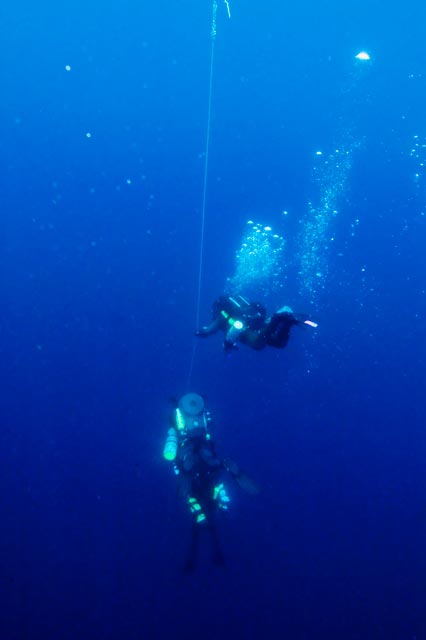
Dan crept on the wreck and made the call: “Drop it!” A one-hundred-pound weight shackled to a twenty-pound sand anchor on a twenty-foot leash of chain screamed into the depths followed by 500 feet of 1/2″ poly line. The morning sun was still low on the horizon; but as the yellow line disappeared into the blue water, we could see we had great surface viz. The two large floats followed by a trail line and smaller ball all went over the side and sat languidly together on the surface…there was still no current. Dan motored around for a half hour confirming the shot was set as we slowly began to kit up.
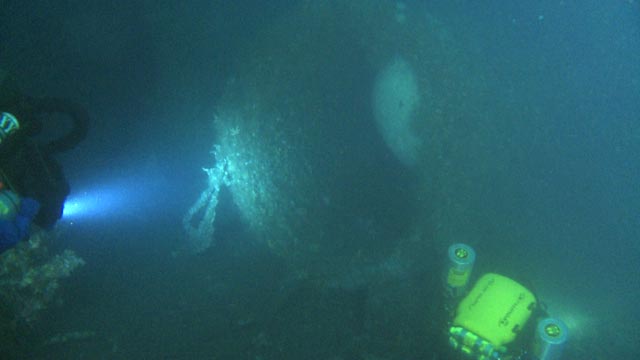
I splashed first, followed by Frankie and then Evan who had brought a huge HD video camera, nicknamed “Big Blue” from WHOI to document whatever waited for us below. After a bubble check, we made our way down the line, hooting and hollering at each other at the stellar viz. At 160 feet, we hit a thermocline and the warm (70 degree) water dropped markedly to the low 50’s but remained clear. Turning and looking back to the surface, we could see the props churning the water, amazed at the near 200-foot water clarity. At 250 feet the shot line began to arc away, and the ever so slight tug of current began to be felt. The ambient light was fantastic, and at around 300 feet dark shadows began to take form below. The yellow shot line angled across the deck and between two large cylinders that I immediately thought were boilers. To my left, dark forms appeared on the deck in a circular pattern that I hoped was a huge paddle wheel. We touched down on the deck at 360 feet and swam forward to check the hook, setting strobes on the line more out of habit then necessity, the viz on the bottom was at least sixty feet in the ambient light. The deck was thick wood with lots of cable and debris spread out, and everywhere there were chain dogfish, hundreds, if not thousands, of them just lying about. The yellow line disappeared straight down a hatch in-between the two “boilers,” an actual hole in one!
Looking down the hatch, a stocky wooden ladder de-scended down into the wreck further than my light could shine. We checked each other, all was good, and began to look around. What looked like boilers were, in fact, large steel cylinders, about six feet in diameter by twenty feet long. One was filled with a large strange white soft coral or hydroid that looked way out of place. The structural members next to the ladder told me what I was already beginning to suspect, but I had to be sure. Frankie and Evan had spread out and their lights played across long wooden beams, cables, pipes, and the odd torn net as we moved over the deck. Reaching a square end of the wreck that was wrapped in a huge floating net, it was obvious that this was no wooden steamship or paddle-wheeler, but a massive barge. As we swam around, we noticed more of the steel cylinders chained to the deck, peered into hatches, and when we came to the semi-circular debris, it was clearly no paddle wheel but the remains of a collapsed deckhouse and wishful thinking. Swimming along the edge of the hull and peering down, it was amazing to see the wreck sitting forty feet off the bottom, with the deck on a 20 degree angle, ready to slide down into the canyon below with a little push. We reconnoitered around the wreck until at 24 minutes it was time to turn the dive. Frankie and I had a great time and enjoyed the dive, but Evan was having camera issues (what else is new?), and we could hear him cursing and grunting. We slowly rolled up the line on our stops, and at 200 feet we tripped a quick release, breaking free of the lower 300 feet of line, the tackle a sacrifice to the wreck. A 20-pound weight was clipped here on the ascent line to keep it taut in the water column. Once free, we shot a red SMB to let topside know we were at 200 feet and now adrift, and all was good. Soon after, our deep support diver, Steve, met us, swapping out tanks and taking our slate topside with our dive details. The next few hours of deco went smoothly, regularly swapping bailout with richer mixes — first with our intermediate support diver, Dan, and then our shallow support diver, Brandon. At one point, we drifted through a strong upwelling of bitterly cold water with reduced visibility and filled with jellyfish. Thankfully, in a short while the warmer, clearer water returned. Unfortunately, no right whales, tuna, or swordfish came by during our deco, only a few curious mahi-mahi and a school of hungry bluefish.
With no niggles or problems, we surfaced and shared with the team the details of the dive. Our mild disappointment at the wreck being a barge rather then a more significant wreck was easily dismissed by the success of the dive and the fantastic conditions we had. With that site ticked off, we now know where a good wreck isn’t, and are already looking at a few other sets of interesting numbers close by.
Searching for new wrecks in deep water is risky business, and you never really know whether you’ll discover anything worth finding. But if you don’t look, you’ll never find anything. On this trip, we didn’t find a primo wreck, just an old work barge. But we did document some funky-looking soft coral that caught the attention of the folks at OCEANA, and has their scientists pretty excited. Who knows, we may have found a new species? We also shared all our dive data with the researchers at DAN to create a data-base of what some CCR technical divers are doing in order to push the line, both with gases and with the decompression algorithms. (Dare I say some of us LIE to our computers???) We all hope that the research we’re contributing to will minimize the risk for the next team.
Technically speaking, every aspect of our dive went according to plan. From the bailout carried to the support team splashing and swapping out on schedule and, with the exception of Evan’s camera, all of our equipment worked flawlessly. But like a shadow behind us, the risk was always there. Each time we push the line, we must be certain that, if our primary systems fail, we have backup to get back home. Doing expedition dives without adequate planning and realistic bailout is like jumping from a plane with only one chute — you may get away with it, but WHEN it fails, you’re dead.