
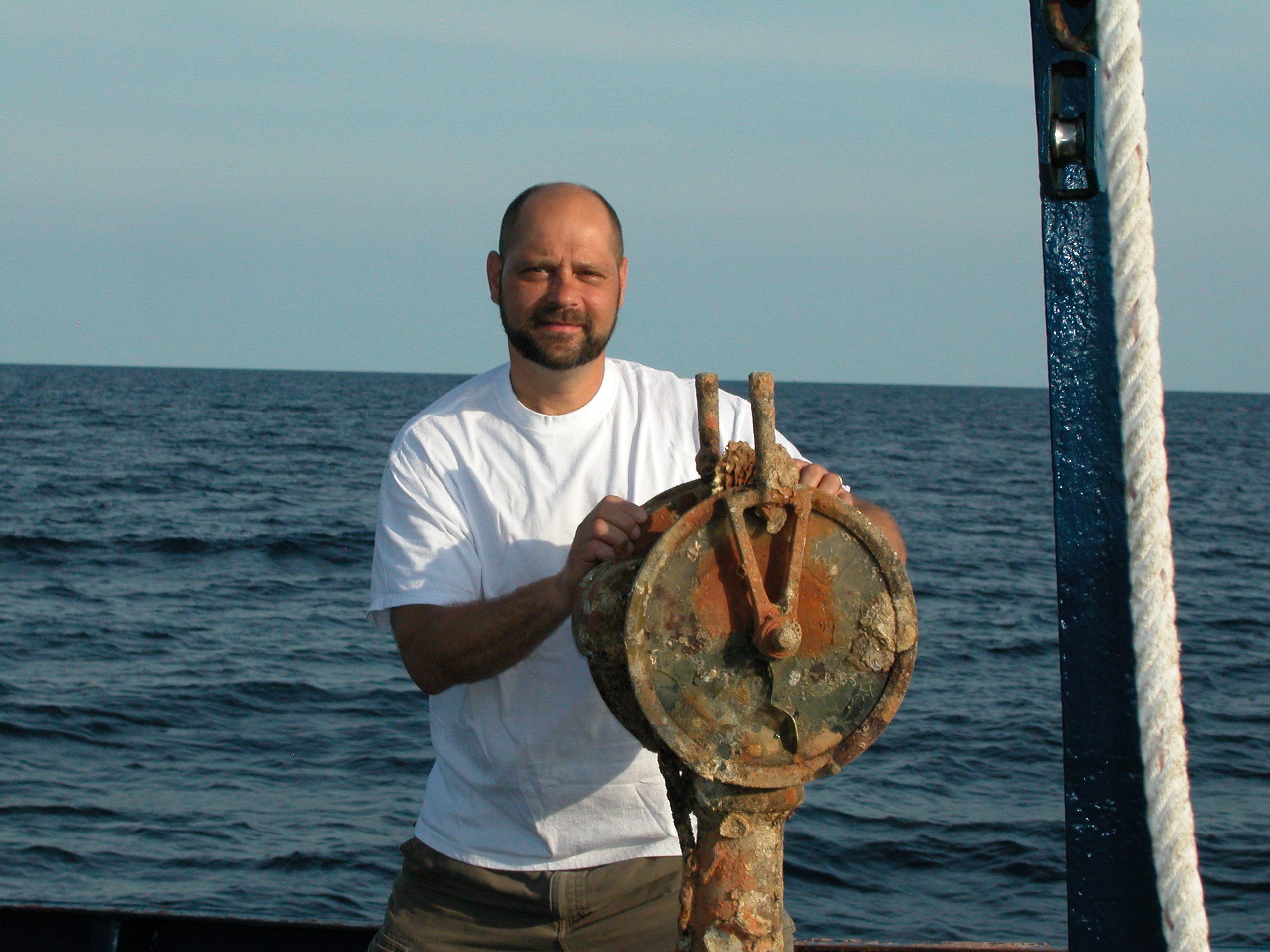
 In our ever shrinking world the opportunity for divers to explore virgin territory, whether it’s a cave system, reef formation or shipwrecks, grows smaller with each passing year. In the last decade, open circuit tri-mix and closed circuit rebreather’shave dramatically expanded the range of the technical wreck diver, and those with the explorer bug are no longer content with the “been there, seen that” sites, so they push further afield in pursuit of diver nirvana, the virgin shipwreck. Putting their money where their mouth is, they motor past the sure thing, the known wrecks, eager to invest the time and money on days of perfect weather to look, look, and look. Many make the ride, “mowing the lawn” for hours on end and pay their dues, but only a few get the chance to be among the first to find a long lost ship. It’s the thrill of the hunt, the amped up adrenaline rush of pulling down a line spiraling into the blue, with no idea of what to expect on the other end. Once bitten, the addiction is hard to shake, and the siren song of the unknown will ring in your ears. For some it’s the booty call of recovering artifacts, for others the desire to capture ghostly images of long-lost vessels before they biologically implode and crumble to unrecognizable pieces of scrap, scattered in the ever shifting sand, rust to dust.
Thailand: A place to discover new wrecks
I know a place where it’s still possible to discover new wrecks, THAILAND. There are many things to like about Thailand, (the people, culture, I know a place where it’s still possible to discover new wrecks, THAILAND. There are many things to like about Thailand, (the people, culture, I know a place where it’s still possible to discover new wrecks, THAILAND. There are many things to like about Thailand, (the people, culture, traditions and food!) but for me virgin wrecks in warm clear water and no dry-suit required is a win/win situation! The adventure begins when you land in Bangkok… a crowded and harried metropolis whose neon splashed nightlife makes NYC look like Iowa. No matter what urban center you’re from, it’s impossible not to be dazzled with the crowded chaos of Bangkok. It’s from here most sport divers head to places like Phuket, Panang, Koh Phangan or Koh Tao; exotic names for equally exotic locales. For years Thailand has attracted international divers to the Andaman Sea on the west coast, with its warm clear water, coral reefs and whale sharks. Off the east coast of the Thai isthmus, the Gulf of Thailand is a bell-shaped body of water stretching from the capital city Bangkok in the north with Cambodia and Viet Nam on the eastern border, and empties into the South China Sea and get this, most of it never gets much deeper than 300 ft! For as long as ships have plied the Gulf of Thailand, typhoons, wars and accidents have sent more than a fair share of them to the bottom, each waiting to be found. Chinese junks, loaded with Ming Dynasty porcelain, sit rotting in the sand next to modern day freighters loaded with cargos of teak and electronics. The ebb and flow of World War II scattered Allied aircraft and submarines next to their victims of Imperial Japanese Maru’s and warships loaded with bombs, bullets and the materials of war.
It was this wild-west frontier for exploration that enticed two British expats, Stuart Oehl and Jamie Macleod to abandon “normal” lives in the UK and live the Peter Pan existence of technical dive operators living on the tropical island of Koh Tao in the Gulf of Thailand. Purchasing 80 ft ex-German patrol boat they turned it into the MV Trident, a technical dive platform with a single purpose; to find shipwrecks. They collected as much historical data as possible from archival sources about shipping losses in the Gulf and began to make friends with any Thai/Cambodian/Vietnamese fishermen they lucked into. Over time, and with a seemingly inexhaustible supply of cigarettes and Heineken beer for barter, they collected a number of “marks” or GPS coordinates of “hangs” from sources known simply as “red boat” or blue boat”. These “hangs” were sites where the fisherman had snagged or lost their nets, or was simply where the fishing was good. Like any other gamble, some sites were a bust while a few others played out and they began to find wrecks like the WWII Japanese freighter SAKURA MARU and tanker NAN MEI #5 and modern wrecks like the SEACREST, an oil drilling ship lost during a typhoon. Upside in 260 feet of water, the wreck is already covered with huge filter feeders, with the two huge props that project up from a field of sea fans and soft corals. You access the turtled ship through the moon pool in its center of the hull at 200 feet and drop down to explore the jungle gym like maze of pipes and deck mounted derrick which lies bent under the hull sixty feet below. The whole of the ship can be accessed from this point, with hatches and companionways stretching into the blackness. In the compartments deep in the wreck, the water is still and anaerobic, and it’s here that remains of the drill ship’s crew have been found.
The Trident team’s success in locating shipwrecks in the Gulf of Thailand was noticed by a US submarine veteran who tasked the team with looking for a sub lost in the Gulf in the closing days of WWII. Since they had a set of numbers very close to where the sub was reported lost they rolled the dice again, heading out 150 miles into the Gulf. There was indeed a mark at the numbers and on the first dive they located the intact remains of a Balao class American submarine! The US Navy dispatched a salvage vessel and a team of US Navy diver’s examined the Tridents find. After sixty years the location of the long lost USS LAGARTO and the fate of her eighty-six crewmen was confirmed. I first met Jamie and Stuart while I was working with the Wisconsin Maritime Museum on a PBS documentary about the USS LAGARTO. After a dive to the LAGARTO they showed me their book of numbers and a list of WWII Japanese Maru’s sunk in the Gulf during WWII. I was excited the prospect of so many targets in a relatively small area so I began running wreck hunting expeditions with them!
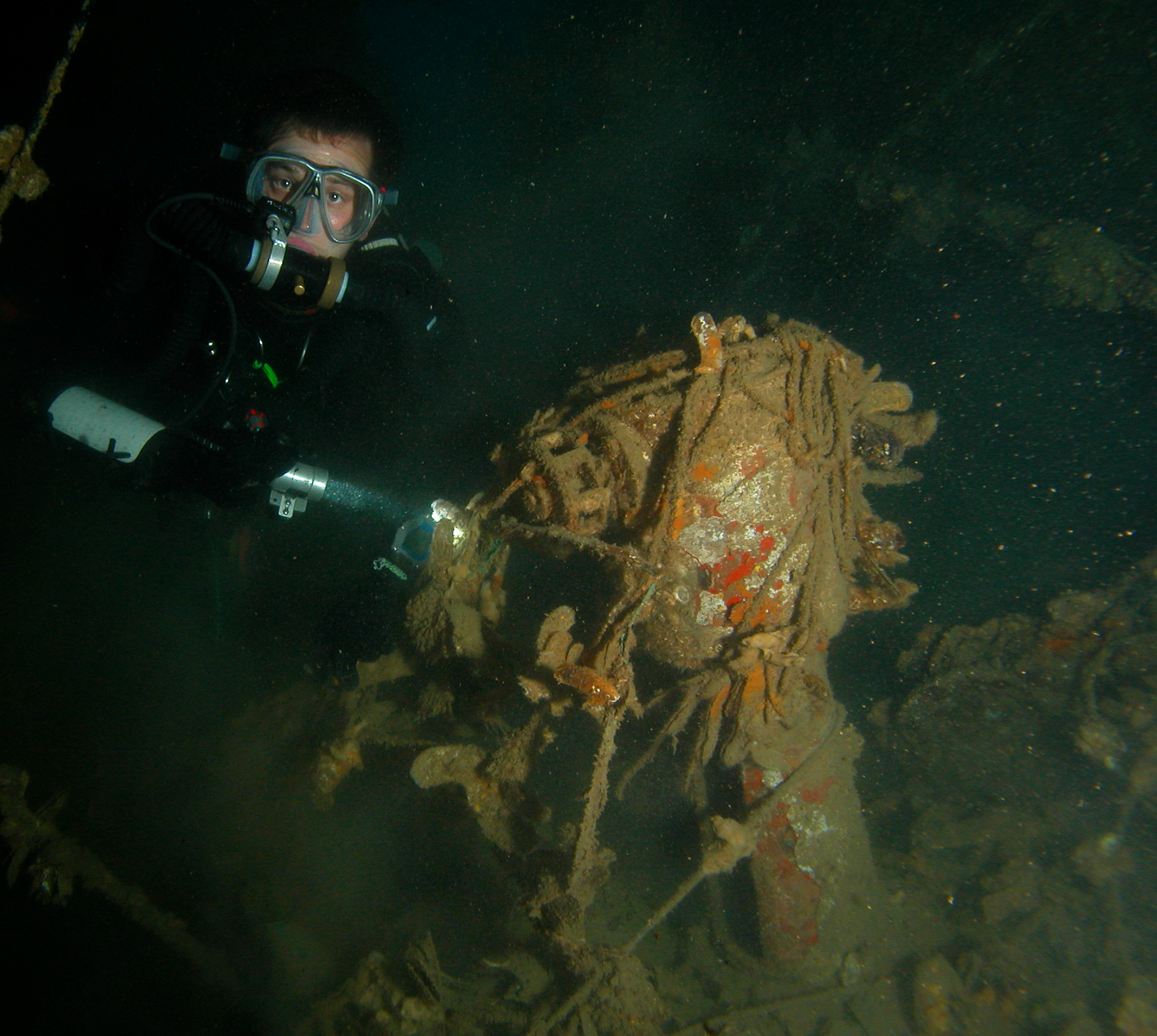
I heard him start hooting and hollering through his breathing loop; Evan had lucked into the most coveted of all wreck artifacts, the ships bell!
On our first expedition we motored to a set of numbers from the squid fishing captain of “redboat” that he said marked as a BIG wreck and true to his word as soon as we hit the crossed his numbers a large object marked hard and tall on the sounder. We had arrived at night and it was hard to sleep knowing a virgin wreck was under our keel. Early the next morning we splashed to find a post-war freighter sitting upright and intact with the forward mast totally covered in nets. There was a huge cut in the hull forward of the bridge on the starboard side which looked like collision damage, and in the chasm was a large ships anchor with the chain disappearing out away from the hull. It appeared that whoever struck this ship lost their anchor in the process. Swimming into the intact bridge it was amazing to see glass intact the square windows and all the navigational equipment in place. As Evan Kovacs posed for my camera next to the helm he looked down on the mud covered deck and spotted an interesting shape. Picking it up he created billows of silt and in the near zero viz I heard him start hooting and hollering through his breathing loop; Evan had lucked into the most coveted of all wreck artifacts, the ships bell! The name engraved into the bronze positively identified this Flying Dutchman as the AKELA.
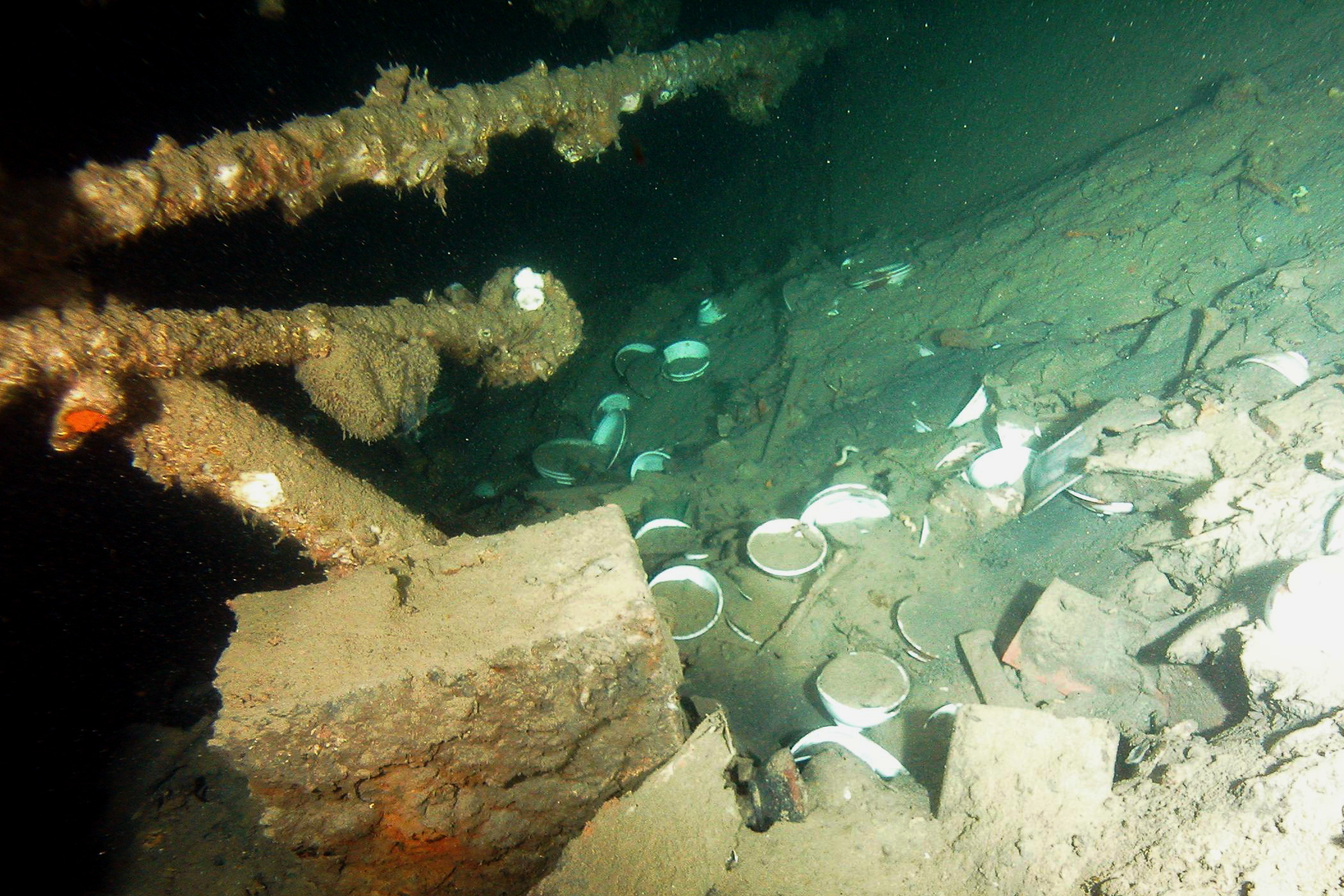 The next wreck we hit was one they had found a few year back but Another WWII freighter was positively identified as the Imperial Japanese “hell ship” TOTTORI MARU when the brass letters with the vessels name were located on the bow. “Hell ships” like the TOTTORI MARU earned the name transporting allied prisoners to Japanese work camps throughout Southeast Asia, under the most horrible and cramped conditions. Packed like sardines into cramped cargo holds, they were often not given any food or water in the equatorial heat and with no toilet facility for the prisoners, dysentery and disease spread like wildfire in the fetid conditions. Many prisoners, already weakened by injury or malnutrition never survived the journey. The wreck has a sharp list to starboard and although the hull is mostly intact the bridge area has collapsed into the sand next to the hull. Swimming around the wreck you can find lanterns, rice kettles, sake bottles, portholes and all over the wreck are stacks of ammunition, (cargo) and hundred s pieces of crockery bearing both IJN (Imperial Japanese Navy) and Nippon Yusen Kaisha(the shipping line) logos. In the stern compartments are stacks of ammunition carried most likely as cargo as no weapons are found on the wreck. Not a bad first trip!
The next expedition traveled 170 miles out of Koh Samui, to within 60 miles of the Cambodian coast to look at a set of hang numbers close to where the USS HARDHEAD reported sinking the Japanese freighter, ARROSAN MARU during WWII. Passing over the numbers (also courtesy of “redboat”) a huge target loomed up on the bottom finder, projecting seventy feet of relief off the bottom! Running over the mark a few times it was clear this wreck was , as Jamie said, “a biggun” The first team down found the shot line passing over huge wall of net, strung taut and extending over fifty feet off the bottom, the ends disappearing into the distance. Hiding behind the curtain of net we found a huge freighter, nearly four hundred feet long and with the stern twisted off to one side. As Jamie said it really was a “biggun”; four cargo holds (empty), two masts and a massive four deck accommodation area amidships. Probably most amazing was the intact funnel rising from the engineering area aft of the bridge most wrecks you simply never see the funnel in place. The only downside to this awesome wreck is it was in too good of condition to be the ARROSAN MARU. Just like the AKELA, all the bridge equipment was in place, even the running light lanterns still sat in place on the bridge wings. This wreck was certainly another virgin, but whom? As the dive team surfaced details about the wreck started to pile up fast; a emergency life saving kit with directions in three languages was recovered, plastic construction “hard hats” were seen inside the crews quarters and packages of “Everready” alkaline batteries in the radio room all pointed to this being another post-war modern era shipwreck. Despite careful searches around the bridge, forecastle and forward mast the bell couldn’t be found, nor was the name found on either the bow or stern so the team decided to name the unknown vessel the CARRIE WRECK after the only woman aboard, my wife Carrie Kohler.
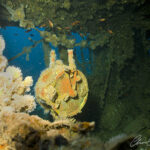
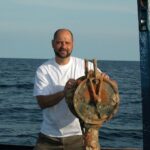
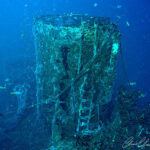
As exciting as it is to find a virgin wreck, Jamie really prefers the older wrecks, primarily those Japanese Maru’s and he still has quite a wish list to locate. My most recent expedition we went searching for the AKITA MARU sunk by the Dutch submarine O-19 about 180 miles south Koh Samui. He had a few sets of numbers in the area courtesy of “blueboat” that once again marked hard and fast as soon as we arrived, and it’s interesting to note that so far there has been no searching, or mowing the lawn just finding and diving when it comes to these fishermen’s numbers! The first was another post war freighter, 220 feet to the sand, its bow shrink wrapped in nets and the mast knocked back into the hold, with all its navigational equipment sitting in the bridge and a cargo of teak planks. Due to difficulty we had in hooking the wreck, a few equipment issues, and a medical problem, we named this one the KLUSTER PHUCK MARU. The second was a small coastal vessel, possibly a fishing mother ship that was very picturesque and again remarkably intact…and there is still so many more to be found. Besides the elusive ARROSAN and AKITA MARU’S there the KINREI MARU, also sunk by the USS HARDHEAD and then maybe what could be considered the prize of Gulf of Thailand wrecks, the Japanese submarine 1-351, sunk by the USS BLUEFISH. So many wrecks, so little time…