
Technical Wreck Diving Incident in the Gulf of Thailand
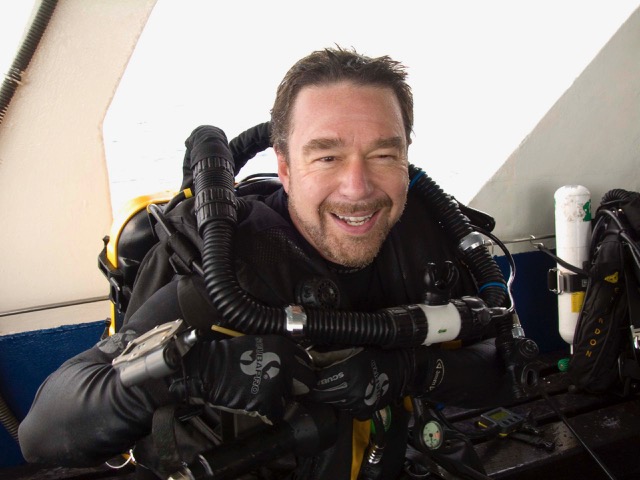
Technical divers regularly push the edge and beyond, so emergencies are prepared for with contingencies neatly ticked off like a detailed shopping list. When the unexpected (or is it expected?) happens, gut wrenching uncertainty spills like foam over the rim of a boiling pot, smearing the ink of our best made plans. Training and preparation can make the difference between an incident and a tragedy. For our complex wreck expedition everything came together smoothly. Our international team assembled from all points of the compass, travel plans synching up with nary a hitch. The weather was picture perfect, loading of the boat clicked along like clockwork, each diver a cog in a well-oiled machine; we even left two hours ahead of schedule! The sixteen hour ride allowed time for everyone to rest then carefully check equipment that suffered the indignities of inspections by ham-fisted security people….200 miles to sea and 270 feet down is not the place to find that your equipment has been buggered!
After a shakeout on a shallow wreck to prudently confirm all equipment was in order, and with the sun burning red on the horizon, we aimed our bow at a promising set of numbers. Our Captain bartered the coordinates from Thai fisherman with beer and cigarettes for “marks” that once snagged nets, which we hoped were virgin shipwrecks. Typhoons and wars have littered the Gulf with Chinese junks, submarines, aircraft, Japanese Maru’s, and even today ships are being lost to tempest and collision. We knew we would find something, but what? The boat continued through the night as our dive team slept, engines slowing to a crawl as we approached the coordinates. Within minutes the captain was relieved to see a shape rise up on the scope; there was indeed a large wreck below!
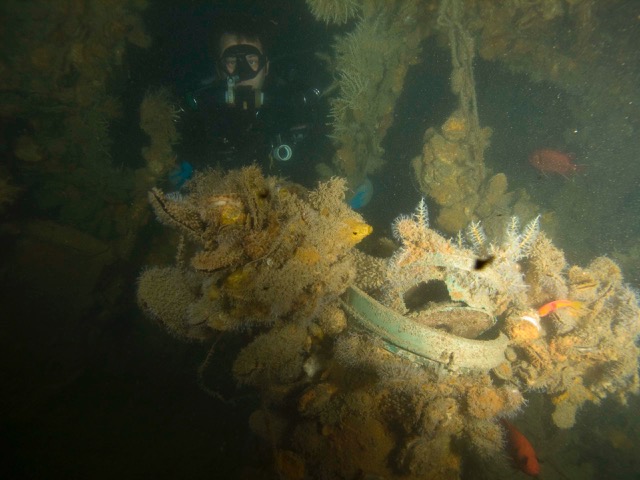
Over breakfast I reviewed some of the problems that virgin wreck exploration holds; floating nets, silt filled interiors, collapsing structure and no option for air-rescue in case of a problem. If a diver had a minor “niggle” or pain-only “hit” we would opt for in-water recompression. Given our remote location diligence and conservative planning was the order of the day. Everyone analyzed their gasses, checked backup systems and filled in runtimes. Once the surface-supplied oxygen was dropped on a decompression (“deco”) bar beneath the boat, we began to descend to whatever waited below.
Conditions were perfect; 87°F (31°C) water, minimal current and 100 ft (30 m) visibility. We had located a large freighter, upright and intact, a cargo of lumber stacked neatly in the holds. Looking in the bridge windows, all the navigational equipment stood in place, and a huge grouper lurked in the companionway, not sure what to make of us. Ascending the forward mast the wreck was obscured by huge shoals of fish. It was an awesome dive! Everyone was elated at our discovery and hoped to identify the lost vessel.
John surfaced and climbed aboard, totally ecstatic about his dive. Settling on the bench he happily recounted his amazement at the totally intact wreck, even seeing the compass in the binnacle stand! While elaborating on his adventure, his expression changed then went quiet and introspective. Questioning what was wrong, he said his calves were achy and he had a sharp pain behind his right knee. I asked if he had done all his deco and cleared both of his computers, he answered “yes.” I suggested he immediately get in back in the water on oxygen, and directed a crewmember to assist and monitor him as I started the in-water recompression plan. Swimming towards the deco station he stopped and with wide eyes said, “My hands aren’t working and I can’t hold on the line.” In less than five minutes, John’s condition had gone from happy and symptom free, to slight niggling pain and now a possible CNS problem! I had no choice but to scrub the in-water recompression and bring him back onboard.
As John lay down on a cushioned bench, the pain became worse and he grew dizzy. Starting him on 100% oxygen from a demand regulator we began to remove his wetsuit. Large ugly red splotches appeared on his chest, stomach and thighs almost before our eyes and within ten minutes after surfacing he experienced extreme vertigo and vomited. There was no doubt John was suffering a bad case of decompression sickness. With John being monitored, I accounted for the rest of my dive team; I still had divers under the boat who couldn’t surface for two hours. I checked John’s dive buddy and the rest of my team, everyone one else was fine. I powered up one of the two satellite (SAT) phones onboard and dialed DAN.
On the opposite side of the world it was 3:00AM and to my relief the operator at Duke University picked up on the second ring. I explained I had a diving emergency and was immediately transferred to a DAN medical technician who calmly asked for the facts, “who, what and where”. I can almost felt the pause when I told him the closest chamber was 180 miles (290 km) away. He read back the details then said the chamber supervisor in Koh Samui would call me directly. An hour had passed since John surfaced and the angry red splotching had spread, his vertigo and retching was intense, and he couldn’t keep any water down. One of our dive team was a paramedic by profession and began monitoring John’s pulse and breathing rate and switched him over from the demand regulator to an oronasal mask. But despite the oxygen and care we provided John was suffering and needed help fast!
We were taking John’s pulse when the ring of the SAT phone startled me; it was Mike Fife, the chamber supervisor from Koh Samui requesting an update on John’s condition. After noting John’s status, he said he would try to arrange a helicopter evacuation, but told me to beat feet back to land as soon as possible. When all my divers were onboard the anchor line was cut and with a rumble the diesels churned the water at maximum revolutions, but even at top speed our best time to Koh Samui was still 18 hours away…
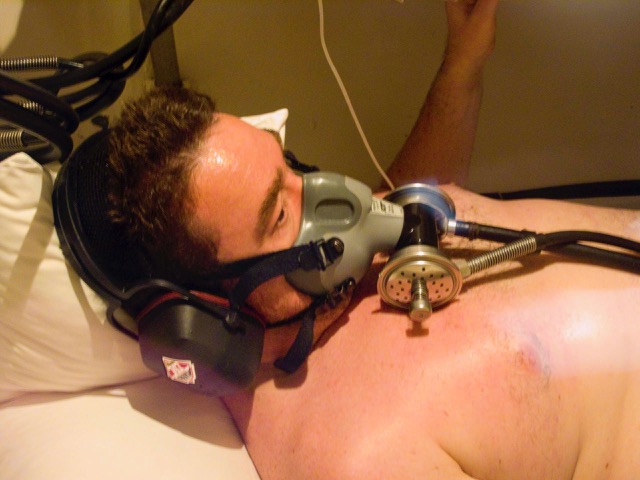
As the day began to fade into night, John grew steadily worse, the heat was slowly sapping his strength and dehydrating him even further. When he tried to sit up he passed out, scaring the wits out of us all. He quickly awoke dazed and confused. His vital signs wavered back and forth, the pain in his legs as constant as the throb of our engines and the red welts irritated him terribly in the heat. We took turns wiping him down with a cool damp cloth to try and ease his discomfort, most of the time he stoically took it in silence, but his eyes spoke volumes. The SAT phone rang again shattering the quiet. It was Mike from the Koh Samui chamber with bad news; there would be no air evacuation. We had to proceed as planned, but he did arrange for a fast speed boat to meet us at first light, roughly fifty miles (80 km) out from Koh Samui. The fast boat would shave three hours off John’s time to the chamber but required excellent seamanship, first to find each other and then to safely make a mid-ocean transfer of a practically paralyzed victim. The Captain proposed a latitude and longitude that would work for both vessels, and I promised to call the chamber if John’s condition changed during the night.
As I powered down the SAT phone, the next ten hours seemed like it would last forever. Dinner was a somber event, as John lay softly moaning next to us. We gave him tiny pieces of watermelon to suck on, but everything came right back up. As our bow carved a phosphorescent “V” through the darkened seas, I drew up a watch list; someone would check on John and take his vital signs every 30 minutes. I took first shift, and before heading to my bunk hastily packed essentials for both John and I, including all John’s medical and emergency information to go with us in the morning. I didn’t think I could, but I was exhausted and with troubled thoughts found a few hours sleep.
Unfortunately John couldn’t sleep as his mind raced and the pain throbbed. Every 30 minutes or so the watch-stander asked how he felt and checked his pulse and respiratory rates. The night dragged on. Before sunrise I came back up to the salon, relieved to find John holding on.
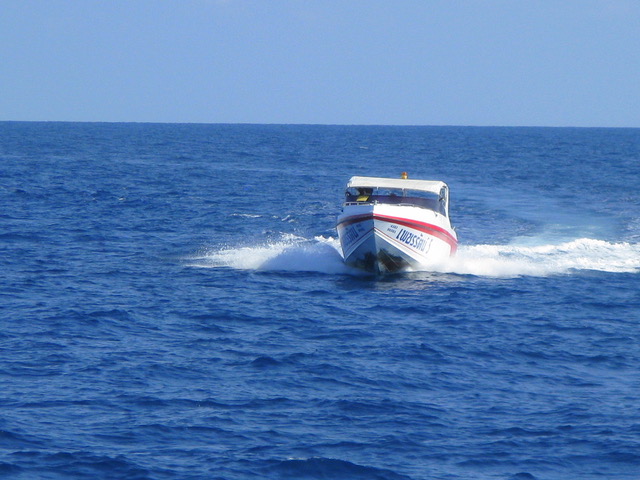
As the sun rose, we closed on the invisible coordinates. With the slowing of the engines everyone was lining the rails, eyes straining for the fast rescue boat. Unfortunately, the horizon was dotted with Thai fishing boats. Minutes dragged by before the rescue boat appeared as a white moustache on the horizon. We anchored our vessel and readied John for the move from the bench. As soon as the 40 ft (12 m) speed boat was secured alongside, a lone figure jumped aboard, it was Mike from the Koh Samui chamber. After a brief update and introduction to John, Mike arranged a litter carry. Thankfully, the seas cooperated and the transfer from the big boat to the speed boat went smoothly. Clutching all the notes taken about John’s situation, I jumped aboard the smaller boat, waving goodbye to everyone lining the rail and wishing us god-speed. The twin outboard engines whined loudly as the speed boat came up on plane and raced for the island that lay out of sight over the horizon.
Mike kneeled next to John, still strapped in the litter, monitoring his condition. As the island grew larger in the windscreen, Mike coordinated the ambulance pickup with our arrival. Once in the bay, the speed boat slowed, slewed around and backed into the beach. I could see the ambulance at water’s edge, emergency personal wading out to meet us. Eager hands grabbed the litter and with their feet barely wet the EMT’s had John in the ambulance. The doctor met us on the beach and began asking John questions as they loaded him into the ambulance, and within minutes of our arrival, John had an intravenous line inserted to replace the fluid he had lost.
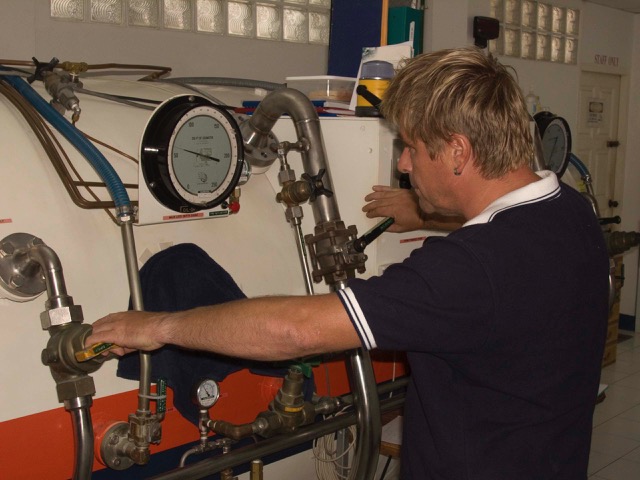
Things seemed to move very fast and before I knew it, John was carried into the multi-place chamber and with a loud clank the large hatch was shut. Mike sat me down, and began to go over all the details of John’s dive and his post-dive condition. As I answered his questions, I watched the chamber operator spin the valves and heard the roar of air as the chamber was pressurized down to 60 ft (18 m). Almost as soon as the chamber reached bottom pressure John’s vertigo lessened but, surprisingly, the pain in his legs grew more intense. Breathing pure oxygen with scheduled air breaks, the pain eventually lessened. Soon he drank water for the first time in 24 hours. This chamber ride was a US Navy Treatment Table 6 (USN TT6), lasting about five hours. John had to be carried into the chamber but walked out, shakily, but walking. He looked and felt much better, even the welts reduced to a slight redness. He then received a full examination at the hospital where the doctor expressed concern that the dehydration may have damaged his kidneys.
Over the next few days John received four more chamber treatments, progressively feeling better and stronger. Fortunately, his kidneys recovered and after his release from the hospital John said he felt better than he had prior to the incident! John and I had a few days left on vacation so we relaxed by the water’s edge and reflected on the trip. Traveling to the opposite side of the world, far from the well-trodden path John suddenly found himself in a desperate and dire situation. Thanks to good planning we were able to contact DAN, get the support needed to set the ball in motion and within 24 hours John was in chamber and on the road to recovery. DAN was there for us, arranging the fast rescue boat, the ambulance at the water’s edge, the chamber and the hospital. The idea of not being able to contact, or worse, not having someone like DAN to help in a diving emergency like John’s is unthinkable.
So what caused the John’s accident? His dive profile had only a 3% risk assigned to it, and he did everything correctly; ascent rate, decompression stops, yet still took a big hit. John is now back home trying to figure out what caused his problem. One of the things he checked was whether or not he had a patent foraman ovale (PFO) to see if this could have contributed to his incident. There is much talk recently about PFO and how it may relate to decompression incidents like John’s. Having a PFO doesn’t necessarily mean you will have a decompression incident (actually the percentages are against it), but in some cases there does seem to be a connection. In his case, he found out that he did have a PFO, too small to show up during rest but clearly open following the Valsalva strain used in testing. It cannot be confirmed that the PFO played a role, but it is possible. If, for example, he had significant bubble formation immediately upon surfacing, the strain associated with pulling himself up the ladder may have prompted the crossover of some blood from the right heart to the left, thereby allowing any bubbles in that blood to avoid the lung where they would likely be filtered out and instead travel towards more sensitive tissues.
One thing that can help researchers at DAN understand incidents like John’s is for all divers, including technical divers, to send their dive computer data to DAN for analysis. With this information DAN researchers can gain valuable insight into the dive profiles, gasses used, and decompression algorithms divers are using every day, worldwide. This database can help shape dive planning for the future and as technical divers continue to go deeper and stay longer, this research will hopefully make it safer. I personally have been submitting my Evolution “Vision” data for three years now, and encourage everyone to join in.
For more information about how to contribute your dive data to DAN, contact them at https://www.dan.org