

My dive was nearly over, and it was time to ascend. I picked up the microphone and keyed it up “John, did you find the ribbons of steel?” After an interminable pause, a one-word reply came back from my partner, “Negative”. His answer was a punch in the gut, immediately sending me to the opposite end of the spectrum. I had up until that point, been making the dream dive of a lifetime, one never thought in a million years I would ever do. Up until that transmission I had been exploring the intact bow of section of arguably the most famous shipwreck in human history, the RMS Titanic, and I was flying high; giddy with excitement at what I had been seeing just a few feet away through the view port. Now it felt as if the whole weight of two and half miles of seawater was pressing down on me and the all the giddiness was gone.
From its inception, nothing had gone right with this expedition. My two partner’s, Kirk Wolfinger and John Chatterton, and I had been buffeted by problem after problem, including losing one whole dive day and having a looming hurricane threatening to blow the whole trip. Johns one-word answer “negative”, meant that our information was wrong, we were wrong, and our project was going to fail. There were no ribbons of steel. Now what?
My exploration of Titanic was still a heady experience, and during the two and half hour it took to ascend I sat quietly in the darkened submersible replaying what I had just seen through my head, and wondering where we could possibly go from here. When we surfaced there were still smiles and laughter, applause and cheers, almost a hero’s welcome. It was a 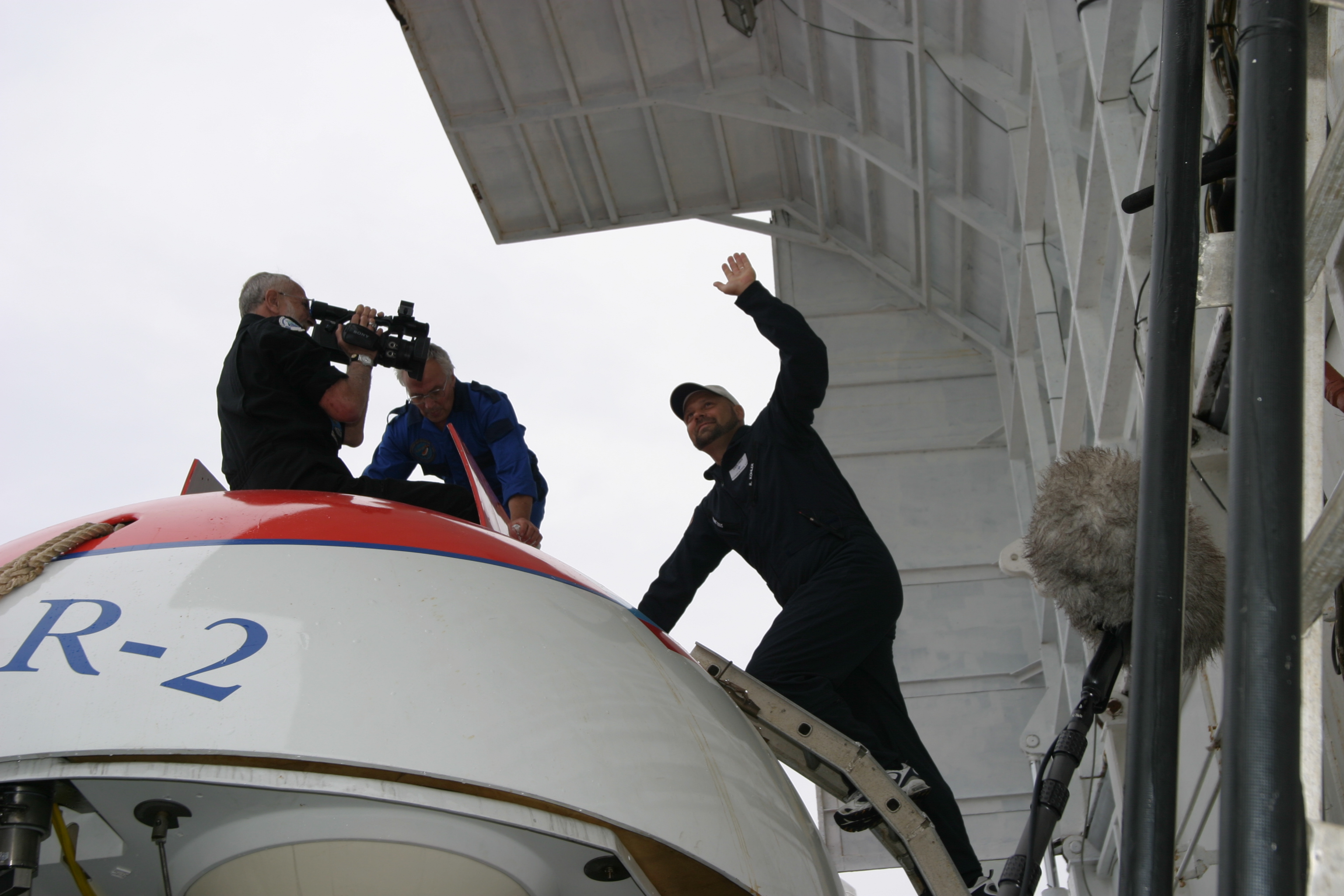 successful dive to 12,500 feet for both of the Russian submersibles, Mir 1 and Mir 2, but we failed to find what we had hoped to find, long ribbons of steel that could have proven the grounding theory. These ribbons we hoped would have been the smoking gun of Titanic’s sinking.
Back aboard the Russian research vessel Keyldish, we reviewed both the track of Johns sub and his footage. It was clear that John and David Concannon had thoroughly searched the area, and there were no ribbons of steel to be found. David’s theory was wrong; what he thought was ribbons of steel, was in fact a twisted box beam, not strips of hull plating ripped from the side of Titanic at the moment of collision with the iceberg. Now what? The answer came from Billy Lang of Woods Hole. He suggested we look out to the east, “far away from the main body of the wreck”. Out there were large objects seen only on sonar, possibly including wreckage that had never been imaged by Dr. Ballard. Maybe out there we could find something of value. It didn’t take much to convince us to follow Billy’s lead. He was a member of the Dr. Bob Ballard’s expedition when the wreckage of the Titanic was first found and a veteran of many trips to the wreck since. If Bill Lang said this was a virgin territory to explore, that was good enough for us. We had one dive day left, one shot to do explore and contribute to the base of understanding about the wreck site. In doing this on our last dive, we could possibly uncover answers to the many questions concerning her sinking including trying to either prove or disprove the grounding theory, and save this expedition.
 The excitement of the original dive was still there when I climbed back up and into the Mir submersible two days later, but my optimism was waning. We had a lot of work to do on this dive. My first dive had been to document the bow section with explorer and cinematographer Ralph White, veteran of many Titanic expeditions and film projects. It was for me the ultimate tourist dive as we not only filmed every iconic spot on the wreck, but then went and searched carefully along the starboard side for damage to the bilge keel. On this dive we would not visit either the bow or stern. We would land to the east of the wreckage, way out in the debris field and head out and away from the wreck, looking for large sonar contacts and investigating each one for significance. We had a huge area to search and opted to use both Mir’s to search for sonar contacts. In Mir 1 Kirk Wolfinger was joined Bob Blumberg of the US State Department, while John and I would be diving in Mir 2. Our pilot would be Viktor and he was taking our Mir to a place neither he, nor any other sub pilot from the Keyldish had ever gone before. As matter of fact none of the Mir pilots had gone searching so far from the main body of wreckage before.
It was not long before we picked up large contacts on our sonar, and soon after Mir 1 also was registering another massive piece off to the south of us. As we closed in on the target a massive section of Titanic’s hull, filled our view ports. We immediately recognized what the deep red paint flashing back in our lights meant; this was a huge and intact section of Titanic’s double bottom hull! Almost to the minute Mir 2 found another intact piece of the bottom section of Titanic. This was amazing to see and for what it could mean in the context of Titanic’s sinking it was exactly what we had hoped to find.

Post dive analysis of the underwater video and photos allowed our team to draw to scale what these two large sections looked like in their entirety. Even more amazing, it was obvious these two sections would fit together perfectly, like pieces of a huge puzzle. Further study revealed that these “missing pieces” as we came to call them, came from exactly the spot were Titanic had broken in half. For many, these pieces change perceptions of what had happened that night, and how it influenced the decisions made by many of the people and crew.
Prior to our imaging of these “missing pieces” many believed that Titanic had hit the iceberg, slowly flooded and sank, breaking apart on its way to the bottom. But careful examination of the edges of these two sections by experts tells a different story… Rather they show that Titanic hit the iceberg and slowly flooded, but broke apart on the surface and sank, a very different experience for those aboard who were hoping for the ship to stay afloat long enough for rescue. It may seem a subtle nuance, but when people are making decisions whether to get in the lifeboat or stay aboard, they may have believed there would be more time to recall and reload the life boats. The break up preceded and facilitated a much more rapid sinking.
For more detail about our 2005 RMS Titanic and 2006 HMHS Britannic expeditions, and the details of our findings, I highly recommend reading “Titanic’s Last Secret’s” by Brad Matson and the History Channel documentaries about the project.